
AI agronomy agents, powered by live plant signals. Not more data to interpret. Practical help from the plant's own response.
Syntheflora measures the plant from within: leaf, stem, root zone, canopy, soil, and environment. Cortex turns those signals into specialized agents for stress, water, nutrition, energy, disease risk, trials, alerts, reporting, and decision support. CoFarmer helps operationalize approved recommendations where integrated.
What Syntheflora measures.
Most instruments describe the crop from the outside. Syntheflora reads the biological processes that determine how the plant is actually doing. The data is organized below by the decision it helps make.
What is the plant experiencing before the canopy shows it?
Stress state.
Tissue impedance, biopotentials, transpiration, and leaf temperature reveal physiological stress before visible symptoms. These signals support early detection of water stress, heat stress, salinity stress, nutrient imbalance, light/CO₂ suboptimality, and pathogen-related anomalies.
Is the plant hydrated, transporting water, and responding to irrigation?
Water dynamics.
Sap flow, stem water status, root-zone conditions, tissue impedance, and transpiration describe the full water journey from root uptake to canopy loss. This is the foundation for yield-safe deficit irrigation.
Is the plant growing, slowing, recovering, or entering a transition?
Growth trajectory.
Biomass sensors measure changes in above-ground and root-zone growth continuously. Instead of waiting for harvest or weekly manual measurements, operators can see growth response after irrigation, nutrition, stress, or climate changes.
What is the plant taking up and moving internally?
Nutritional and metabolic state.
Electrochemical impedance spectroscopy helps distinguish ionic and organic movement through plant tissues. Chlorophyll and flavonoid signals provide insight into photosynthetic capacity, nitrogen status, oxidative stress, and secondary metabolite response.
Are young plants establishing, responding uniformly, and ready for transplant?
Propagation readiness.
For seedlings, cuttings, clones, mother plants, and young transplants, Syntheflora can track early stress, root establishment, water uptake, nutrient response, and batch uniformity before visual losses appear.
Which conditions produced the plant response?
Environmental response.
Environmental context is recorded alongside physiology: PAR, spectral light, air temperature, humidity, CO₂, ozone, particulate matter, soil temperature, soil moisture, and other deployment-specific channels.
One biological picture. Multiple sensor zones.
Each zone captures a different dimension of plant state. Together they form a complete physiological picture — from root to canopy, continuous and in real time.
| Zone | Core signals | Why it matters |
|---|---|---|
| Leaf | Transpiration, temperature, chlorophyll, flavonoids | Stomatal behavior, photosynthesis, stress, quality markers |
| Stem | Tissue impedance, sap flow, biopotentials, EIS | Internal transport, hydration, nutrient movement, systemic stress |
| Root zone | Root biomass, irrigation uptake, soil moisture, soil temperature | Uptake efficiency, root health, substrate risk, propagation establishment |
| Canopy | PAR, spectral reflectance, biomass context | Light exposure, photosynthetic context, vigor |
| Environment | Air temperature, humidity, CO₂, ozone, PM, light | Interpretation context and stress drivers |
| Advanced modules | NMR, ion-selective electrodes, biochemical integration | Research, regulated crops, high-resolution phenotyping |
The agents make plant physiology usable.
The value of Syntheflora is not in any single channel. It is in the relationships between channels: tissue impedance shifting while sap flow changes, transpiration drops, root uptake slows, and environmental demand rises. Interpreting that pattern in real time historically required a plant physiologist with expertise in electrophysiology and biophysical data.
Syntheflora brings that interpretation into the operating layer. Gemini or another approved model interprets multisensor physiology and returns plain-language agronomic meaning: what is happening, why it matters, what action is recommended, and which signals support the recommendation.
The system does not ask growers to become data scientists. It gives them specialized agents with specific jobs.
Cortex is the agent layer behind Syntheflora.
Syntheflora Cortex connects edge sensing, AI interpretation, specialized agents, and CoFarmer execution into a closed-loop architecture. It is designed for commercial agriculture, large cultivations, greenhouses, propagation operations, remote outdoor deployments, and institutional monitoring.
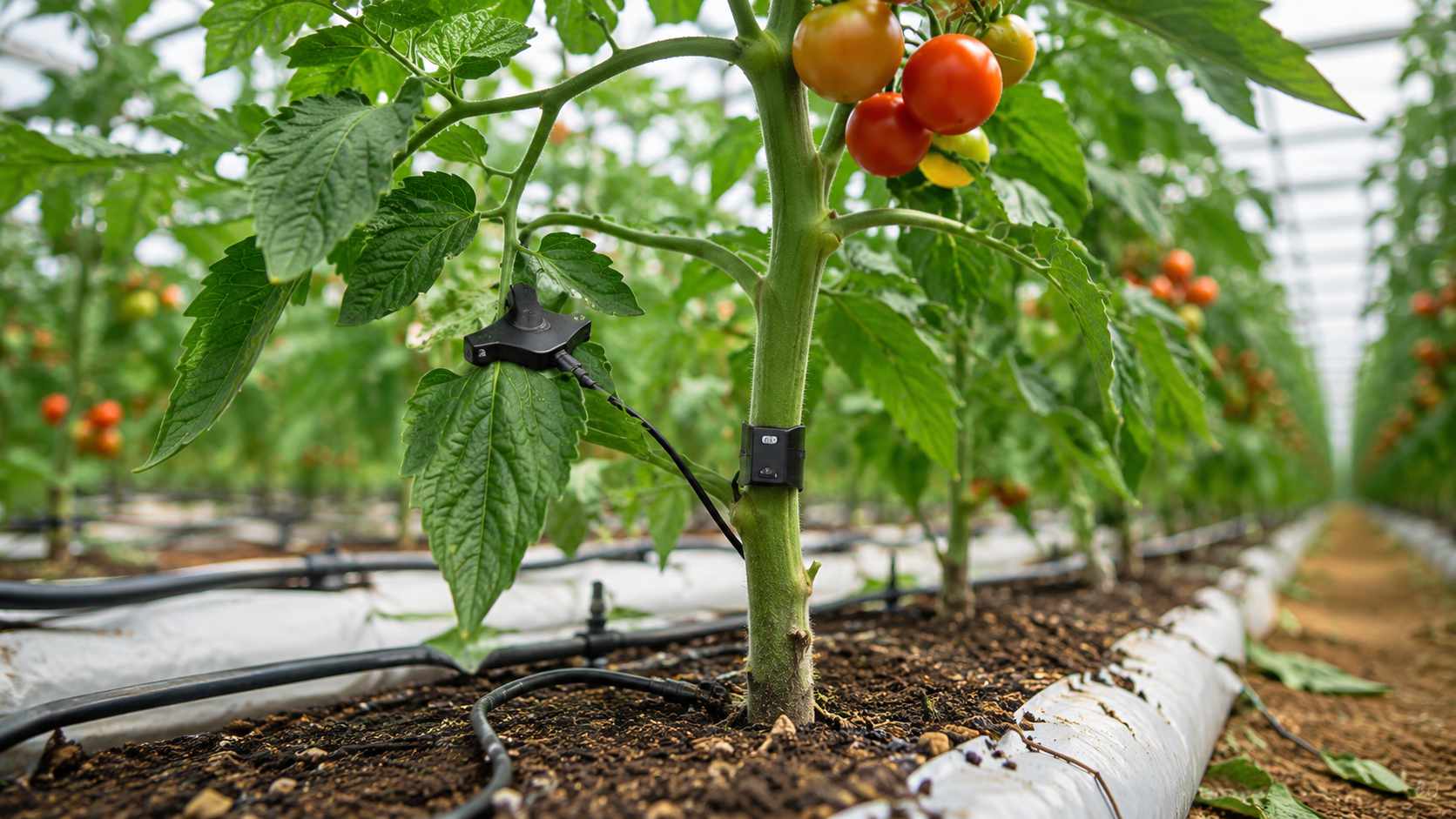
The CYBRES sensor array captures live plant physiology at configurable intervals.
Electrodes, optical sensors, thermal sensors, and impedance arrays operate simultaneously across leaf, stem, root zone, canopy, and environment.
Local modules filter, compress, and structure dense plant signals.
Only useful semantic features travel across the network. Threshold-based controllers can act on real-time data without cloud dependency — the plant does not wait for a server response.
Specialized agents synthesize cross-zone plant-state data.
Gemini or another approved model interprets multisensor physiology and returns plain-language agronomic meaning: what is happening, why it matters, what action is recommended, and which signals support the recommendation.
Actions are executed through CoFarmer partner infrastructure where integrated.
Irrigation, lighting, CO₂, HVAC, fertigation, alerts, farmer workflows, and reporting logs — all within operator-defined limits.
Every action stays within operator-defined limits.
Advisory, supervised, and automated modes are supported. The grower decides what the agents can and cannot do.
The agents.
Each agent has a specific responsibility. Together they cover the full range of crop decisions a commercial operator needs to make.
| Agent | Function | Grower value |
|---|---|---|
| Stress Detection & Early Warning Agent | Classifies pre-symptomatic stress signals | Intervene before visible damage |
| Water Optimization Agent | Interprets hydration, sap flow, transpiration, uptake, and recovery | Adjust irrigation from plant response |
| Fertigation / Nutrition Agent | Interprets nutrient, EC, uptake, and stress response | Reduce input waste and improve fertigation decisions |
| Energy Optimization Agent | Aligns light, CO₂, HVAC, and climate with plant activity | Reduce wasted energy in CEA |
| Pathogen Early Warning Agent | Flags unusual multi-signal stress patterns | Prioritize scouting or lab confirmation earlier |
| Phenotyping & Screening Agent | Compares varieties, treatments, biologicals, and crop inputs | See treatment response before end-of-cycle outcomes |
| Micro-Trial Orchestration Agent | Tests parameter variants across zones | Learn in hours or days, not seasons |
| Alert & Notification Agent | Routes and prioritizes intervention guidance | Reduce alert noise and response delay |
| Decision Support Agent | Produces explainable recommendations | Keep operators in control |
| Environmental Reporting Agent | Structures physiological and environmental data | Support ESG, GACP, GMP, and government reporting |
| Carbon & Water Accounting Agent | Connects water events, plant response, and reporting context | Support water stewardship and sustainability documentation |
Propagation and transplant-readiness can be packaged as a focused use case using the Stress, Water, Fertigation/Nutrition, Phenotyping, Micro-Trial, and Decision Support agents.
Agronomic learning should not take a season when the plant responds in hours.
Traditional field optimization waits for visible or harvest-stage outcomes. Syntheflora Cortex can test parameter variants across zones and measure immediate physiological response: sap flow stability, impedance shifts, transpiration, biomass response, or stress recovery.
In a greenhouse or propagation house, this may resolve multiple cycles in a short period. In outdoor or solar-powered deployments, trials may resolve over hours or days. In both cases, the learning loop is radically faster than waiting for the next season.
Zone A tests one irrigation threshold. Zone B tests another. Zone C tests a third. Cortex compares plant response, identifies the best-performing parameter within grower-defined limits, and recommends or applies the update across similar zones through CoFarmer where execution is connected.
Deployment modes.
Syntheflora is configured to match the operation — not forced into a single product shape.
| Mode | Best for | Configuration |
|---|---|---|
| Commercial Agriculture | Greenhouses, vineyards, orchards, specialty crops | Sensor suite + AI interpretation + operational support |
| Large Cultivation | Multi-zone farms, estates, large greenhouse operators | Representative plant-state stations + zone logic + water/input efficiency workflows |
| CEA / Greenhouse | Vertical farms, high-energy greenhouse crops, regulated botanicals | Plant-state sensing + energy/water/input optimization + BMS integration |
| Propagation / Nursery | Seedlings, cuttings, clones, mother plants, young transplants | Young-plant sensing + root establishment + uniformity and transplant-readiness support |
| Outdoor / Remote | Vineyards, orchards, sentinel stations, water-stressed regions | Rugged deployment, low-bandwidth options, solar/off-grid where configured |
| University Research | Plant science, agronomy, phenotyping, AI research | Raw data, Python/API access, CYBRES support, near-cost pricing |
| Government / Institutional | Drought, ecological, food security, water accounting | Sentinel stations, dashboards, data sovereignty options |
Data, privacy, and integration.
Data ownership
Operational data belongs to the grower, institution, or programme operating the system. Any use of anonymized or aggregated findings for research or model improvement requires explicit agreement.
Exports
Data can be exported in structured formats for CoFarmer workflows, ERP, LIMS, cultivation management, compliance, research, and external analytics workflows.
Research access
Research configurations support raw data export and Python/API workflows. Commercial configurations prioritize AI-interpreted operational outputs while preserving exportable time-series data.
Integration
Syntheflora is an intelligence layer that works with CoFarmer, irrigation and fertigation infrastructure, greenhouse controls, BMS, ERP, LIMS, cultivation management platforms, and reporting tools. It does not need to replace a grower's existing control stack to make it more plant-aware.
Cortex architecture can support cloud, regional, or local/on-premise model deployment depending on client requirements.
Seen enough to map it to your operation?
The best way to understand Syntheflora is to discuss the crop, infrastructure, region, and decision you need to improve.